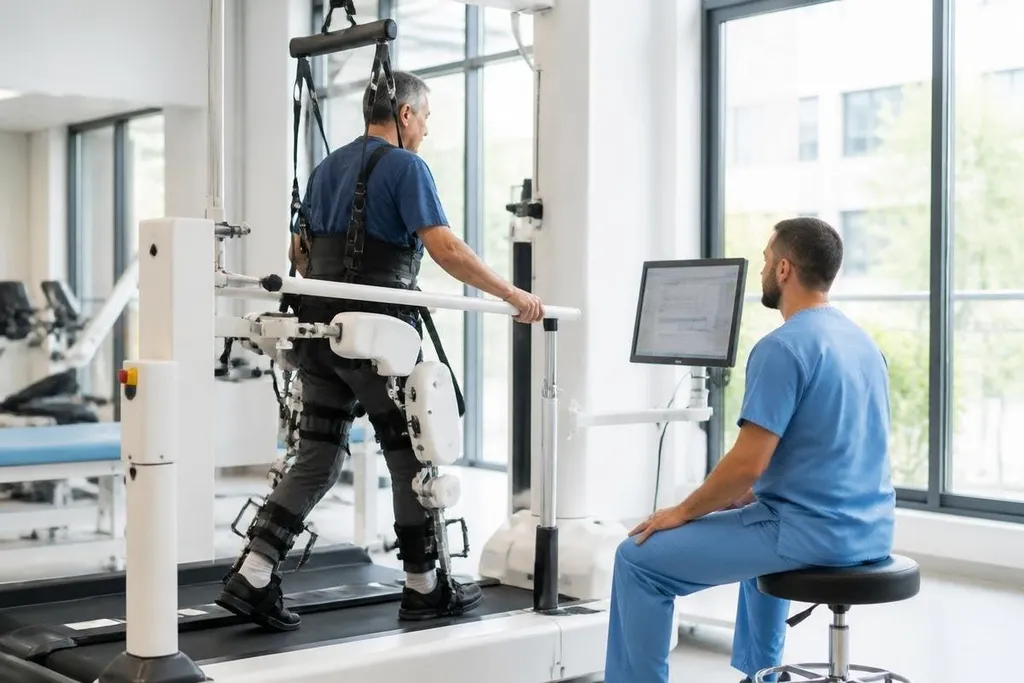
A rehabilitation robot can repeat the same assisted movement for a long session while recording how the person responds. That matters when recovery depends on steady practice after a stroke, spinal cord injury, or other movement problem.
Quick read
- Repeated movement gives therapy more practice time.
- Sensors can record force, speed, and range of motion.
- A robot still needs a therapist to set goals and check safety.
Where robots fit in therapy
Rehabilitation robots usually work on one movement at a time. A gait robot may help a person place each foot during walking practice, while an arm device guides reaching or supports the weight of the limb.
That narrow focus helps the therapist control the task. They can adjust how much of the movement the robot supplies, then ask the person to do more as strength and control return.
The setting must match the person’s ability, because too much help can reduce the work the muscles need to do. Repetition is the main reason these systems matter.
A person may tire, lose balance, or need a pause, while the robot can keep the movement path steady across many attempts. The therapist can spend that time watching posture, pain, attention, and signs of fatigue instead of guiding every motion by hand.
The robot doesn’t replace that judgment. It handles a measured movement under supervision, while the therapist decides what the movement should train.
What the robot can measure
Many systems use sensors to record joint angle, speed, force, or the amount of help given. Those records can show whether a person is reaching farther, placing more weight on one leg, or doing more of the work without support.
That record gives the therapist a clearer starting point for the next session. It can also help them change the task in small steps, such as lowering the robot’s assistance or adding a longer walking period.
Measurement matters for another reason. Recovery can feel uneven across sessions, so one session may give a poor view of change. A set of session records gives the care team more information than memory alone.
Session records become more useful when you can compare them with the robot, care setting, and measured result behind a trial. Rehabilitation robotics reporting from Robot24.com can add that context before the next section looks at who can access these systems.
Why access is part of the question
A rehabilitation robot needs space, trained staff, maintenance, and a care plan. The system may help a clinic run repeated exercises, but it can also add setup time and cost.
That creates a practical limit for smaller clinics and home users. A device that works well in a research setting may need a simpler control system, easier cleaning, and clear safety checks before staff can use it across a busy therapy schedule.
Home use raises more questions. The person may need help putting on a brace or placing a limb correctly. A remote check can guide some sessions, but it doesn’t remove the need for a clinician to review the plan.
The open question is how much therapy a robot can add outside a clinic without making care harder to manage. That answer will differ by device, injury, home setting, and level of supervision.
A practical check before buying or adopting one
Use these points when you compare a system for a clinic, research program, or home plan:
- Name the movement: Check whether it trains walking, reaching, grasping, balance, or another task you need.
- Set the help level: Confirm that staff can change how much force the robot supplies.
- Check the records: Find out which measures it stores and whether staff can read them after each session.
- Plan for safety: Ask how the device stops when pain, loss of balance, or an unexpected movement occurs.
- Count the staff time: Include fitting, cleaning, charging, training, and maintenance in the plan.
- Test the care path: Decide who sets goals, reviews results, and changes the exercise plan.
My view is that rehabilitation robots earn their place when they give a person more useful practice without taking the therapist out of the session.
The next measure to watch is simple: whether clinics can use these systems often enough, safely enough, and with less staff strain than hands-on practice alone.